
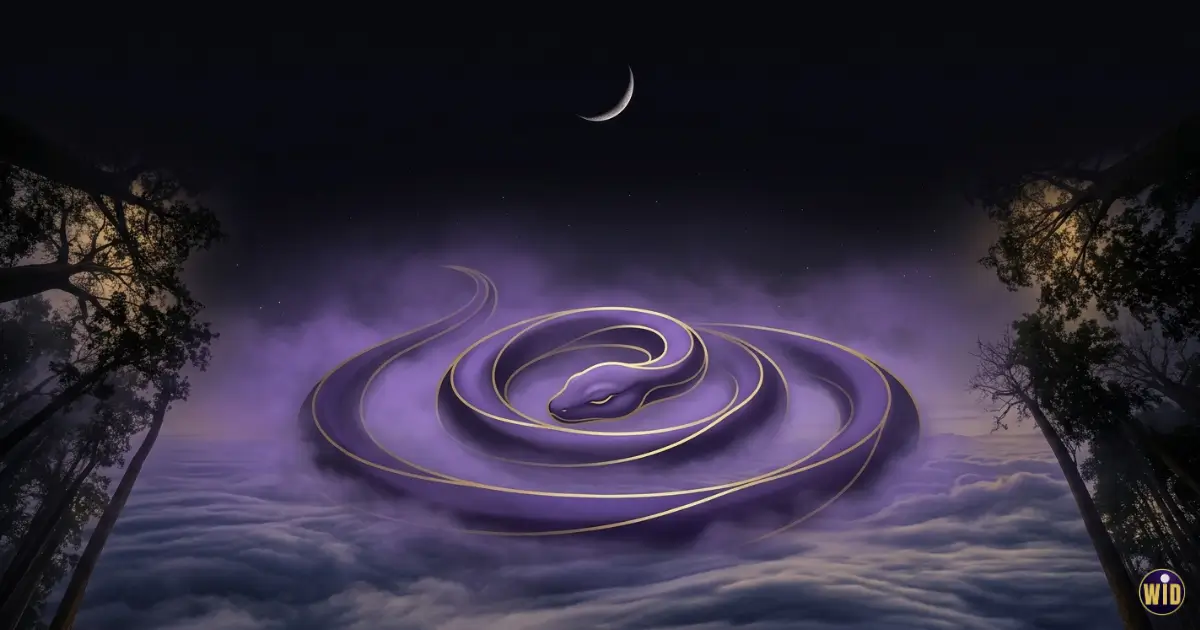
Dreaming of a Snake: Why It Is Almost Never What You Fear
A snake appears in your sleep and you wake up unsettled, certain it means something bad. Here is what most people get wrong. The snake is one of the most misread symbols in the entire dream world, and its real meaning is often the opposite of dread.
It was three in the morning in Phoenix. David woke up slowly, not with a start, which surprised him later. In his dream, a large black snake had crossed his living room, gliding without hurry across the floor, passing a few feet from where he stood. It did not strike. It did not even look at him. And instead of the terror he expected to feel, David felt something closer to calm, a strange quiet he could not explain as he lay in the dark.
He was thirty-eight, halfway through a career change he had been circling for a year, afraid to fully commit. The snake stayed with him through the morning. Not as a threat. As a question he had been avoiding.
This is the paradox at the heart of snake dreams. We are wired to fear the snake, and yet across Jungian psychology, the tradition of Ibn Sirin, and West African spiritual thought, the serpent is rarely a symbol of danger alone. It is a symbol of what is changing in you, whether you have named it or not.
Most people assume a snake dream is a warning about an enemy or a hidden threat. That reading exists, and we will get to it. But the snake carries an older meaning that the fear response hides: the animal that sheds its skin has always stood for the part of you preparing to leave an old life behind.
5 Meanings of Dreaming About a Snake
The snake sheds its skin and emerges new. For this reason it has stood for transformation in nearly every culture that ever watched one move. When a serpent appears in your dream, the most common deeper meaning is that something in you is being renewed, and the old form no longer fits.
Carl Jung saw the snake as one of the oldest symbols of the unconscious itself, the part of the psyche that operates below awareness and drives change from underneath. A snake dream often arrives at a threshold, just before or during a period when your life is quietly reorganizing itself.
In my experience with dreamers, the people who dream of snakes are almost always in the middle of a transformation they have not yet named. The snake precedes the change. It does not cause it.
Sometimes the snake is not renewal but avoidance. In Jungian terms it can represent the shadow, the part of yourself you refuse to look at directly: an anger you suppress, a truth you sidestep, a fear you keep behind a closed door.
When the snake in the dream feels menacing, it is worth asking what in your waking life you are treating the same way, keeping at a distance rather than meeting it. The dream is not punishing you. It is showing you where your attention refuses to go.
There is one detail that changes a snake dream more than any other, and most people overlook it entirely: not the color, not the size, but what the snake was actually doing when you saw it.
Long before the snake was a symbol of danger, it was a symbol of medicine. The staff of Asclepius, still used on medical emblems today, is wrapped by a single serpent. A snake dream can signal a return of vitality, a body or a spirit beginning to heal.
Sigmund Freud read the snake as a phallic symbol tied to sexual energy, a reading no longer accepted by every specialist, but one that points at something real: the serpent is often about life force, drive, and the raw energy that moves a person forward.
The reading everyone reaches for first does exist. A snake can represent a person you do not fully trust, a situation that feels quietly dangerous, or a tension you sense but cannot yet prove. The unconscious is good at noticing what the waking mind talks itself out of.
If the snake in your dream was hidden, coiled in a corner, or striking without warning, it may mirror a relationship or circumstance where you feel exposed. The dream is not a prophecy. It is your own perception, amplified enough for you to finally hear it.
In several spiritual traditions, the serpent coiled at the base of the spine represents dormant energy waiting to rise. A snake dream can mark the beginning of a spiritual opening, a period when questions of meaning press on you more urgently than usual.
When the snake rises, faces you calmly, or seems almost to communicate, the dream often points less to fear and more to awareness. Something in you is waking up and asking to be taken seriously.
The color and behavior of the snake refine the meaning, but remember as you read the table below: your own feeling during the dream outweighs any general correspondence.
Common Symbolic Associations
These are frequent associations, not fixed rules. What you felt matters more than the color or the movement on their own.
| Dream detail | Common association | Worth exploring if… |
|---|---|---|
| Black snake | The unknown, the shadow, something not yet faced | You sense a change coming that you have not named |
| White snake | Clarity, spiritual insight, a turning point | You are seeking direction or a decision feels near |
| Green snake | Growth, renewal, healing, fresh energy | Something in your life is beginning again |
| A snake that bites you | A wake-up call, a truth that finally lands | You have been ignoring a feeling that keeps returning |
| A snake that flees from you | A fear losing its grip, a threat shrinking | You are reclaiming ground you had given away |
| A calm, still snake | Contained energy, a transformation underway peacefully | You are changing quietly without crisis |
| Killing the snake | Overcoming a conflict or an inner obstacle | You are ready to end something that has drained you |
Islamic Interpretation: What Ibn Sirin Says
Ibn Sirin, the primary classical authority on Islamic dream interpretation, gave the snake close attention. In his framework the meaning shifts with the color, the setting, and above all the outcome of the encounter.
| Situation in the dream | Ibn Sirin’s interpretation |
|---|---|
| A snake inside the home | A rival or a source of tension close to the family |
| A snake in open ground or the wild | A more distant adversary, or an obstacle outside the home |
| Killing a snake | Victory over an enemy, resolution of a conflict |
| A black snake | A powerful opponent or a weighty concern |
| A white snake | A weaker matter, or an issue more easily settled |
| Being bitten by a snake | Harm from the direction of the adversary, a caution to stay alert |
| Catching a snake without fear | Gaining the upper hand, control over a difficult situation |
African Symbolism and Traditions
Across much of West Africa, the serpent carries meanings that have little to do with menace. It stands more often for continuity, for water, and for the link between generations.
Among the Yoruba of Nigeria, the rainbow serpent Oshumare represents movement, renewal, and the cycle that connects the heavens to the earth. A snake in a dream can echo this idea of a passage between one state of life and another, a reminder that change is part of a larger order rather than a rupture to be feared.
Among the Fon of Benin, the serpent Dan, often depicted biting its own tail, stands for continuity, life, and the wholeness that holds the world together. In this tradition the snake is closer to a guardian of balance than to a bringer of harm, and a dream of one can point to a life seeking its own equilibrium.
The Question That Unlocks Everything
Before assigning a meaning, ask yourself one thing: when the snake appeared, what did you feel, and what did the snake actually do? Fear and calm point in very different directions, and the snake’s behavior is the clearest key the dream gives you.
David, the man in Phoenix who woke at three in the morning, kept returning to one detail: the snake had not attacked. It had simply passed through, unhurried, as if it belonged there. Weeks later he understood why the dream had left him calm instead of afraid. The change he had been circling was not a danger approaching. It was a version of himself already on its way, crossing the room while he watched.
Dream Journal: Three Questions to Sit With
Write your answers right after waking, before the dream fades.
- What was the snake doing? Passing by, coiled, striking, fleeing? Its behavior usually carries the core of the meaning.
- What did you feel, honestly? Fear, calm, curiosity, disgust? That emotion is the second key, and it is often more telling than the snake itself.
- What in your life right now feels like it is shedding an old skin? Name it plainly before the feeling slips away.
Re-read your answers in one week. Meaning tends to sharpen with a little distance.
“A snake in a dream is almost never what you think it is. Most of the time, it is exactly what you needed to see.”
Full Summary
- Transformation and renewal: the animal that sheds its skin stands for the part of you leaving an old life behind.
- The shadow: a menacing snake can mark what you avoid facing, and what you avoid often holds something you need.
- Healing and life force: long a symbol of medicine, the serpent can signal returning vitality and raw forward energy.
- A warning: the snake can mirror a person or situation you quietly distrust, your own perception amplified.
- Spiritual awakening: a rising or calm snake can mark the start of a deeper opening and greater awareness.
- Islamic reading (Ibn Sirin): most often an adversary, with color and outcome shaping the meaning; killing the snake reads as victory.
- African traditions: Yoruba and Fon perspectives connect the serpent to renewal, continuity, and balance rather than to harm.
- The key question: what did the snake do, and what did you feel? Behavior and emotion together unlock the dream.